
Confused about architect vs contractor vs builder and who you actually need to hire first? You’re not alone. Most people planning a home for the first time assume these three roles overlap more than they actually do, or worse, think one person handles everything. They don’t. Each role covers a different part of the process, and hiring the wrong one for the wrong job is one of the most common (and expensive) mistakes homeowners make early on.
This guide breaks down architect vs contractor vs builder in plain terms, what each one actually does, where their responsibilities overlap, and how to figure out who you need and when. Whether you’re just starting to plan or already deep into interviewing professionals, this should clear up the confusion fast.
What Does an Architect Actually Do?
An architect is the person who turns your vague ideas into an actual, buildable plan. They handle design, spatial planning, and the technical drawings that everyone else on the project works from.
Specifically, an architect’s role usually covers:
- Understanding your lifestyle, needs, and budget, then translating that into a workable layout
- Creating detailed architectural drawings and floor plans
- Ensuring the design complies with local building codes and zoning requirements
- Coordinating with structural engineers on load-bearing elements and structural feasibility
- Advising on materials, aesthetics, and how natural light and ventilation should flow through the space
An architect is essentially the vision-and-planning person. They’re not typically the one physically building anything, their job finishes largely at the design and approval stage, though many stay involved through construction to make sure the build matches the original plan.
What Does a Contractor Actually Do?
A contractor is the person who takes the architect’s plan and actually executes it. They manage the physical construction process: labor, materials, timelines, and the day-to-day coordination that turns a drawing into a real structure.
A contractor’s responsibilities typically include:
- Sourcing and managing construction materials
- Hiring and supervising labor, masons, electricians, plumbers, and other tradespeople
- Managing the construction timeline and keeping the project on schedule
- Ensuring the build follows the architect’s design and structural specifications
- Handling on-site problem-solving when something doesn’t go according to plan, which happens more often than anyone would like
If the architect designs the home, the contractor is the one who actually makes it exist. Good contractors also tend to catch design issues early, ones that only become obvious once construction starts, and flag them back to the architect before they become expensive problems.
What Does a Builder Actually Do?
This is where a lot of the confusion in architect vs contractor vs builder actually comes from, because “builder” gets used differently depending on context. In some cases, a builder is essentially the same as a contractor, someone who manages and executes construction. In other cases, particularly with larger residential or real estate projects, a builder refers to a company that handles the entire process end-to-end, design, construction, and sometimes even the sale of the finished property.
A builder’s role, especially in the second sense, typically includes:
- Overseeing the full project lifecycle, from initial planning through final handover
- Coordinating architects, contractors, and engineers under one unified process
- Managing budgets, approvals, and timelines at a higher level than a single contractor might
- In real estate contexts, sometimes developing and selling properties directly rather than building for an individual client
Companies like Choudhary Builders often function this way, handling architecture, construction, and project management together, so clients aren’t left coordinating separate professionals themselves.
Architect vs Contractor vs Builder: Key Differences
Laid out side by side, the distinction gets a lot clearer.
Architect: Designs the home, creates technical drawings, ensures code compliance, focuses on planning and aesthetics.
Contractor: Executes the physical construction, manages labor and materials, keeps the project on schedule and on budget.
Builder: Either functions like a contractor, or in larger setups, manages the entire process end-to-end, sometimes including architecture and contracting under one roof.
The biggest point of confusion in architect vs contractor vs builder discussions usually comes down to that last point. A “builder” isn’t a fixed, universally defined role the way an architect or contractor is. It shifts depending on the company and the market, which is exactly why it’s worth asking directly what services a specific builder actually provides before assuming.
Do You Need All Three, or Just One?
This depends entirely on your project and how you want to manage it.
Hiring separately (architect, then contractor) gives you more control over each stage and lets you choose specialists for each role. It also means more coordination on your end, since you’re the one making sure the architect’s vision and the contractor’s execution stay aligned.
Hiring a builder who handles everything simplifies coordination significantly, since one company manages architecture, construction, and project oversight together. You lose a bit of the granular control that comes with hand-picking each specialist, but you gain a single point of accountability, which matters a lot when something goes wrong and you need a clear answer about who’s responsible.
For most homeowners building a single residential property, going with a builder who offers integrated services tends to reduce stress considerably, provided that builder has genuine in-house expertise across all three areas rather than just subcontracting everything out anyway.
Common Mistakes People Make With Architect vs Contractor vs Builder Roles
A few patterns show up repeatedly when people misunderstand these roles.
Assuming a contractor can design a home properly. Some contractors have decent design instincts, but without formal architectural training, code compliance and structural planning can suffer. Complex projects genuinely need an architect’s involvement.
Assuming an architect will supervise daily construction. Architects typically aren’t on-site managing labor day to day. That’s the contractor’s job. Expecting an architect to catch every on-site issue in real time usually leads to disappointment.
Not clarifying what a “builder” actually includes before hiring one. Since the term varies so much, assuming a builder handles design when they actually just execute construction (or vice versa) leads to gaps nobody catches until it’s too late.
Hiring based on price alone without understanding scope. A cheaper quote sometimes reflects a narrower scope of services, not better value. Understanding exactly what’s included, design, execution, supervision, before comparing quotes prevents this.
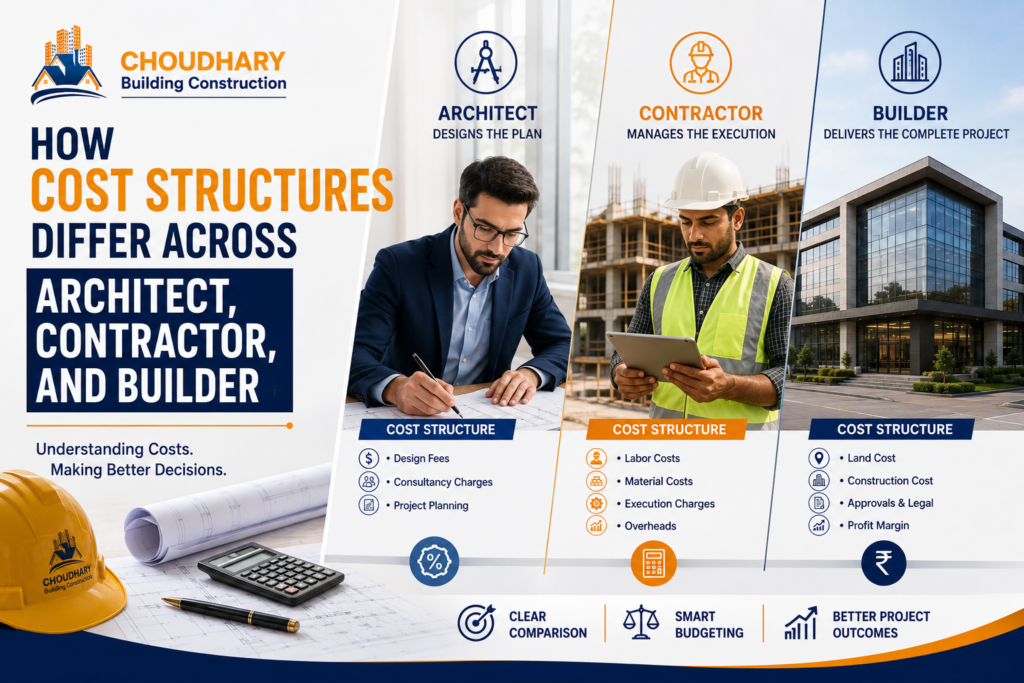
How Cost Structures Differ Across Architect, Contractor, and Builder
Understanding how each role gets paid also clears up a lot of confusion in the architect vs contractor vs builder decision, since the payment structure often reflects what you’re actually buying.
Architects typically charge either a flat design fee or a percentage of the total project cost, since their work is concentrated in the planning and design phase rather than spread across the entire build. Contractors usually charge based on the scope of construction work, sometimes a fixed quote, sometimes cost-plus pricing where materials and labor are billed with a management fee on top. Builders offering integrated services often bundle these together into a single project cost, which can make budgeting simpler but also makes it harder to see exactly where your money’s going unless you ask for a detailed, stage-wise breakdown.
Whichever route you choose, always ask for a clear breakdown of what’s included in any quote, design fees, construction costs, supervision, and any contingency built in for unexpected issues. A vague lump-sum number, regardless of which of the three you’re hiring, tends to hide details that matter.
How to Decide Who to Hire First
If you’re building from scratch, the architect generally comes first, since you need a proper design and set of approved plans before construction can begin. From there, you either bring in a contractor to execute that plan, or work with a builder who can handle both design and execution together from the start.
A few questions worth asking yourself before deciding:
- Do I want granular control over each stage, or a single point of contact managing everything?
- Is my project complex enough to genuinely need separate specialists, or straightforward enough that an integrated builder makes more sense?
- How much time do I realistically have to coordinate between multiple professionals myself?
- Does the company I’m considering as a “builder” actually have in-house architectural and construction expertise, or are they just outsourcing pieces of the process?
FAQS
1. Can a contractor also act as an architect?
Generally not in a formal sense. Contractors focus on execution, not design, and typically lack the specific training required for architectural planning and code compliance. Some have basic design input, but complex projects genuinely need a qualified architect.
2. Is a builder the same as a contractor?
Sometimes, yes, but not always. It depends on the company. Some builders function exactly like contractors, while others offer full end-to-end services including architecture and project management.
3. Do I need an architect for a small home?
Generally, yes, even smaller homes benefit from proper planning and code-compliant design. The scale of architectural involvement might be smaller, but skipping it entirely often leads to inefficient layouts or compliance issues later.
4. Who’s responsible if something goes wrong during construction?
This depends on what stage the issue occurred at and who was responsible for that stage. This is exactly why clear contracts defining each party’s scope matter so much, especially when working with separate architect and contractor teams.
5. Is it cheaper to hire an integrated builder instead of separate professionals?
Not necessarily cheaper, but often more efficient, since you’re not paying for duplicate coordination work or dealing with gaps between separate teams. Cost depends more on the specific company and project than on which hiring approach you choose.
6. Does Choudhary Builders handle both architecture and construction?
Yes. Choudhary Builders offers integrated architect vs contractor vs builder services under one roof, covering design, construction, and project management, so clients don’t need to coordinate separate professionals themselves.
7. How do I verify a builder’s actual scope of services before hiring?
Ask directly what’s included, architectural design, structural engineering, construction execution, and site supervision, and ask for examples of past projects where they handled the full process end-to-end.
8. Can I switch from separate professionals to an integrated builder mid-project?
It’s possible but usually complicated, since it can involve re-establishing plans, contracts, and expectations. It’s far easier to decide on your approach before construction begins than to switch partway through.
Final Thoughts on Architect vs Contractor vs Builder
Understanding architect vs contractor vs builder upfront saves you from hiring the wrong professional for the wrong job, or worse, assuming someone’s responsible for something they were never actually meant to handle. Architects design, contractors execute, and builders either do one of those jobs or manage the entire process depending on how the company’s structured.
Before hiring anyone, get clear on exactly what they’re responsible for, and get it in writing. That clarity protects you if something goes wrong later, and it makes the whole process considerably less stressful either way.
If you’d rather not coordinate separate professionals yourself, reach out to Choudhary Builders. Their team handles architecture, construction, and project management together, so you get a single point of accountability from initial design through final handover.