
There’s a reason so many families choose house construction in Uttarakhand over building elsewhere. The hills, the quiet mornings, the kind of air you just don’t get in the plains. It’s a good place to put down roots.
But before anyone pours a single bag of cement, there’s a paperwork trail that most first-time builders don’t see coming. Miss a permit here, skip an NOC there, and you’re suddenly staring at fines, a paused site, or a demolition notice for a house that already cost you lakhs. We’ve seen it happen. It’s avoidable.
This is the approval checklist we walk our own clients through, roughly in the order you’ll need it.
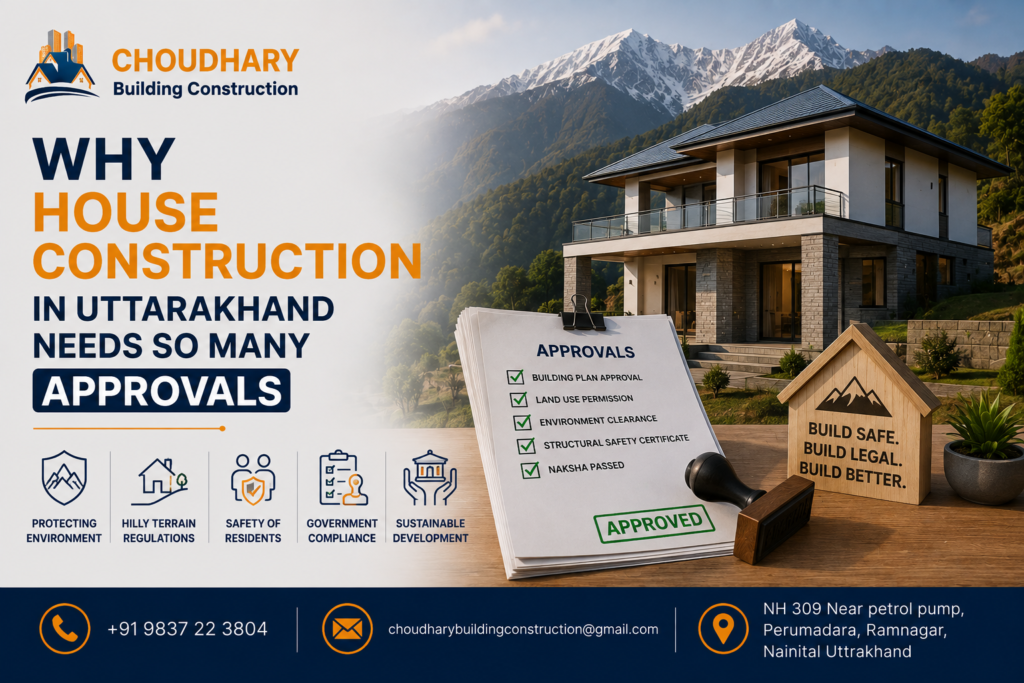
Why House Construction in Uttarakhand Needs So Many Approvals
House construction in Uttarakhand comes with more rules than most people expect, and there’s a reason for that. Uttarakhand isn’t flat, open land where you can build however you like. It sits in an earthquake zone, and much of the state borders forest or river ecosystems that the government is understandably protective of. That’s the real reason the process here has more steps than, say, building in a plains city.
Getting approvals sorted isn’t red tape for the sake of it. It actually does a few things for you:
- Keeps you out of ownership disputes years down the line
- Confirms someone qualified has checked the structure for safety
- Protects what the house is worth when you eventually sell
- Makes bank loans far easier to get approved
- Removes any risk of a demolition order landing on your desk later
A house without these papers isn’t really yours yet, not in any legal sense. It’s just a structure sitting on land with a question mark over it.
1. Land Use Certificate (LUC)
Almost every house construction in Uttarakhand starts here. The LUC is what confirms your land is officially cleared for residential use, which matters a great deal if the plot was originally agricultural land.
You’ll get it from the Tehsildar or the District Magistrate’s office. Get this before you even draft a building plan, because without it, technically speaking, whatever gets built afterward counts as unauthorized.
2. Building Plan Approval
For any house construction in Uttarakhand, once the land use question is settled, the building plan needs sign-off from your local authority, which could be the Nagar Nigam, Nagar Palika, Gram Panchayat, or a development body like MDDA or HRDA depending on where you’re building.
Expect to submit:
- Architectural drawings
- Structural design
- A site plan
- Proof of ownership
- An area statement
One thing homeowners don’t always realize: if you change the layout halfway through construction without telling the authority, that alone can bring a stop-work notice, even if every other document is perfectly fine.
3. Environmental Clearance
This one doesn’t apply to everyone, but it’s worth checking early rather than finding out mid-project. If your plot sits near a forest edge, close to a river, or inside what’s classified as an eco-sensitive zone, you’ll need this clearance before construction starts.
It exists mainly to make sure building activity in these more fragile areas doesn’t do lasting damage to what’s around it.
4. Forest Department NOC
Land near forest boundaries, and there’s a fair bit of it around the Jim Corbett belt and several hill zones, needs a No Objection Certificate from the Forest Department. This isn’t optional or a formality. Building without it is prohibited outright.
5. Structural Stability and Earthquake Safety Certificate
Uttarakhand falls under Seismic Zones IV and V. That’s the higher end of India’s earthquake risk map, so earthquake-resistant design isn’t a suggestion for house construction in Uttarakhand, it’s a requirement.
A licensed structural engineer signs off on this, confirming your design follows the relevant IS codes. What you’re really getting is confidence that the house will hold up over decades, not just pass a one-time inspection.
6. Revenue Department Clearance
This step is about making sure there’s zero ambiguity around who owns the land and where its boundaries actually sit. Before construction begins, the plot should be:
- Registered properly in your name
- Free of pending disputes
- Clearly demarcated
It’s the kind of thing that feels unnecessary until an ownership dispute surfaces five years after you’ve moved in.
7. Gram Panchayat Approval
Building in a village or a rural stretch of the state? You’ll need sign-off from the Gram Panchayat too, even for a small, single-storey home. They’ll typically ask for land ownership proof, a site plan, your ID, and a filled-out Panchayat application.
8. Water and Electricity Connections
Easy to push this to later, but that’s usually a mistake. Water connections go through Jal Nigam or your local water authority, and electricity through the Uttarakhand Power Corporation Limited (UPCL). Apply for both while the house is still being built so you’re not left waiting once it’s ready to move into.
9. Sewage and Drainage Clearance
Particularly in urban and semi-urban parts of the state, this is a mandatory piece of the process. Authorities want to see safe waste disposal, no risk to nearby rivers or groundwater, and general compliance with sanitation rules before they sign off.
10. Completion and Occupancy Certificates
Once the house is finished, two last documents make it official: the Completion Certificate and the Occupancy Certificate. Together they confirm the finished structure matches what was approved, that it’s genuinely safe to live in, and that it can legally be sold or mortgaged down the line.
[Image 3: Keys handover moment, or the exterior of a completed home. Alt text: “Occupancy certificate ready home built by Choudhary Builders Uttarakhand”]
A few more things worth checking
Before construction starts, it also helps to confirm:
- Local building bylaws in your specific municipality or panchayat
- Height and FAR (Floor Area Ratio) limits on your plot
- Road access approval, especially if you’re building on a hillside
- Setback distances from your plot boundaries
- Whether your contractor is actually registered and licensed
Mistakes we see again and again
A handful of patterns show up constantly with first-time builders in the state. Starting work before approvals come through. Not accounting for environmental restrictions on hill or forest-adjacent land. Changing the layout mid-build without updating the approved plan. Hiring a contractor who turns out not to be registered at all.
Any single one of these can turn into a costly delay. Sometimes worse.
Where a builder actually earns their fee
This is usually where working with an experienced local builder pays off. Someone who’s done this before handles the back-and-forth with government offices, keeps the paperwork moving in the right sequence, makes sure the structural design actually meets code, and keeps the project from stalling in approval limbo for months.
A few questions people usually ask
How long does the whole approval process take? Depends on your plot and location, but for a straightforward residential site with no forest or environmental complications, most people are looking at somewhere between 4 and 10 weeks.
Does every plot need Forest Department clearance? No, only if your land borders forest boundaries or falls within a buffer zone. That’s fairly common near Jim Corbett and parts of the hill belt, but it’s not universal.
Can construction start while approvals are still pending? It shouldn’t. Starting before your building plan is approved counts as unauthorized construction and can bring a stop-work order, no matter how far along the build already is.
Is the earthquake safety certificate really needed for a small house too? Yes. Since the whole state falls under Seismic Zones IV and V, this requirement doesn’t change based on the size of the house.
Final thoughts
None of this paperwork is the exciting part of building a home. But it’s what turns a construction project into something you actually own, safely and legally. From the first Land Use Certificate to the final Occupancy Certificate, each step is there to protect the money you’re putting in and the family that’s going to live there.
Whether you’re building near Ramnagar, close to Jim Corbett, or anywhere else in the state, getting this right from day one saves a lot of time, money, and stress later.
Planning to build in Uttarakhand? Choudhary Builders handles the entire approval process alongside the construction itself, so you can focus on the part that’s actually exciting.
A few questions people usually ask
How long does the whole approval process take?
Depends on your plot and location, but for a straightforward residential site with no forest or environmental complications, most people are looking at somewhere between 4 and 10 weeks.
Does every plot need Forest Department clearance?
No, only if your land borders forest boundaries or falls within a buffer zone. That’s fairly common near Jim Corbett and parts of the hill belt, but it’s not universal.
Can construction start while approvals are still pending?
It shouldn’t. Starting before your building plan is approved counts as unauthorized construction and can bring a stop-work order, no matter how far along the build already is.
Is the earthquake safety certificate really needed for a small house too?
Yes. Since the whole state falls under Seismic Zones IV and V, this requirement doesn’t change based on the size of the house.
Who issues the Land Use Certificate for house construction in Uttarakhand?
The Tehsildar or the District Magistrate’s office issues the LUC. It’s usually the very first document you’ll need, especially if the land was originally classified as agricultural rather than residential.
What happens if I change my building plan mid-construction without approval?
Even a small, unapproved change to the layout can trigger a stop-work notice or penalty from the local authority, regardless of how good the rest of your paperwork looks. Any deviation from the approved plan needs to go back through the same authority for sign-off.
Do I need separate approvals for water and electricity connections?
Yes. Water connections go through Jal Nigam or your local water authority, while electricity connections are handled by the Uttarakhand Power Corporation Limited (UPCL). It’s worth applying for both while construction is still underway.
Why should I hire a professional builder instead of managing approvals myself?
It’s possible to do it yourself, but an experienced local builder already has working relationships with these departments and knows the sequence approvals need to happen in. That alone often saves months compared to figuring it out as you go.