
Winter construction in Ramnagar is usually easier than people expect. The real constraint here is monsoon, not cold. Concrete gains strength more slowly at low temperatures and needs longer curing, and daylight is shorter — but October to March is the longest clear working window of the year.
Every year around this time somebody asks whether winter construction is a bad idea and they should wait until spring.
The thinking is that cold weather is bad for building. Which is true in places that actually freeze. Ramnagar isn’t one of them.
Sit with the calendar for a minute. Monsoon runs roughly June through September and it genuinely stops work — not slows, stops. That leaves October to May. Of those, April and May are workable but hot, and anything you begin in May walks straight into the rain before the structure is up.
So the long clear stretch is the one that starts now.
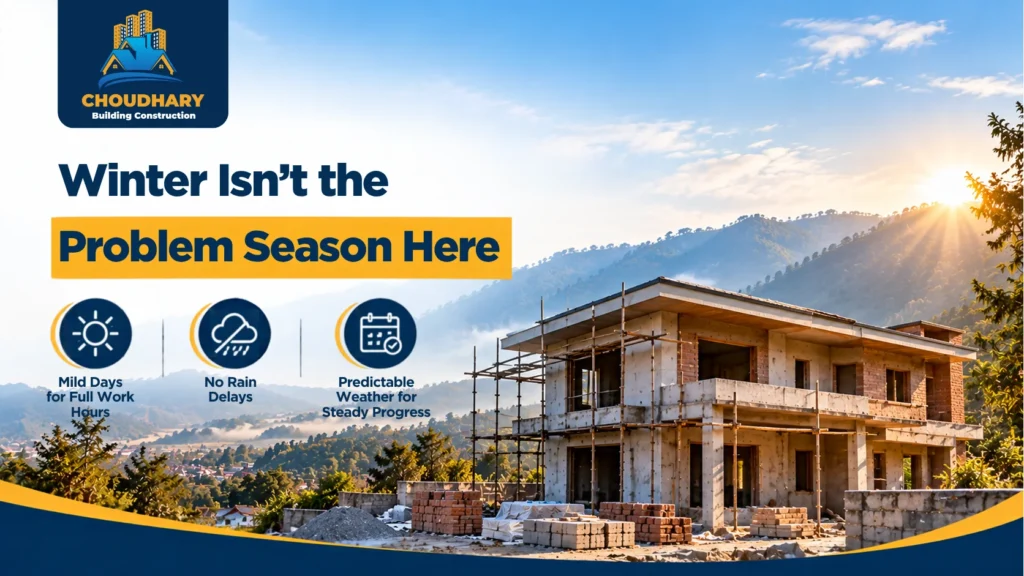
Winter Isn’t the Problem Season Here
Winter construction here isn’t what it is in places that freeze. We’re in the foothills, not the high Himalaya. Days through the cold months stay mild enough to work full shifts. Nights drop, and that matters for concrete, but it’s manageable with the right curing approach.
What you get in exchange is four or five months of predictable weather. No week lost to rain. No slab postponed three times. No site turning to mud every time a truck needs to come in.
Winter construction buys you that clear run. Ask anyone who has built here through a monsoon which season they’d rather have.
What Actually Changes in Cold Weather
Winter construction isn’t the same as summer construction. A few things genuinely shift, and a contractor who ignores them will cost you.
Concrete Takes Longer
Cement hydration slows as temperature drops. Concrete still gains strength, just more slowly, which means two practical changes.
First, de-shuttering has to wait longer. If your contractor strips formwork on the same schedule he’d use in April, the slab hasn’t reached the strength he’s assuming. This is where cold-weather damage actually happens, and you won’t see it until the ceiling cracks a year later.
Second, curing matters more, not less. Concrete still needs water through the cold months, and it needs protecting from the coldest part of the night. Covering fresh pours is routine practice, not an extra.
Your site engineer should be adjusting the schedule for temperature, following cold-weather concreting practice as set out in the National Building Code of India. If nobody mentions it, ask.
Shorter Working Days
Light goes early. A crew that works until six in June is packing up by five thirty in December, and on a foggy morning they may start late too.
That’s maybe an hour a day. Over three months it’s real, and an honest timeline accounts for it rather than pretending the day is the same length all year.
The Stages That Suit Winter Construction Best
Some work is actively better in the cold months.
Earthwork and foundation — the ground is dry and firm, which makes excavation cleaner and gives trucks a surface they can actually drive on. Try the same in July.
Masonry and plaster — plaster that dries too fast in summer heat tends to crack. Cooler weather gives it a gentler drying curve.
Interiors, flooring, carpentry, painting — all of this is indoor work, unaffected by the season, and perfect for the shortest days.
Site logistics generally. Material arrives when it’s supposed to because the roads are dry.
What’s Better Left for Later
Not everything. A few things do want warmer weather.
Any large slab pour in the coldest weeks needs planning rather than just scheduling — the curing window stretches and the site has to be set up for it.
Some waterproofing and paint products specify a minimum application temperature. Worth checking the datasheet rather than assuming, particularly on terrace treatments.
And external painting on a damp, foggy morning is wasted effort. It needs a dry spell.
Should You Start Now or Wait Until March?
Depends entirely on where you are.
You have drawings and approvals ready. Start now. You’ll have the structure up and be into interiors before the rain comes. Waiting until March means casting slabs in May and June, which is the worst possible timing.
You’re still at the design stage. Use winter for drawings, approvals and material decisions. Begin site work in February and you’re still ahead of monsoon.
You’re renovating or doing interiors. Winter is close to ideal. The work is indoors and the weather is irrelevant.
You haven’t bought the plot yet. Buy now, do the site preparation through winter — boundary, levelling, soil testing — and start building next October with everything ready.
The one timing I’d argue against is starting a new structure in April. It feels like the sensible season and it isn’t, because you run out of clear weather before the roof is on.
Labour Over the Winter Months
Worth knowing: availability is often better now than in spring.
Fewer projects run through the cold months because so many owners assume they shouldn’t. That means crews are easier to secure, and a good team isn’t being pulled across three sites at once.
Material supply is steadier too. Dry roads, predictable deliveries, no waiting for a truck that can’t get up a wet track.
Talk to Us About Timing
If you’re weighing up whether to start now, the useful conversation is about your specific stage — what’s ready, what isn’t, and what the realistic sequence looks like from here.
We’ll go through it honestly. Sometimes the answer is start immediately. Sometimes it’s spend winter on drawings and approvals and begin site work in February. Both are better than waiting for a spring that quietly turns into monsoon.
Choudhary Builders works through the winter season across Ramnagar and Peerumadara, on new construction and on renovation alike.
Call +91 98372 23804 or send us your details. Bring your drawings if you have them, and we’ll map out a timeline that works backwards from next monsoon rather than forwards from today.
FAQs
Q1. Is winter construction a bad idea in Ramnagar?
Usually not. The real constraint here is monsoon, not cold. Days are mild enough for full shifts and the clear stretch from October to March is the longest working window of the year. Choudhary Builders works right through it.
Q2. Does cold weather affect concrete?
Yes. Strength gain slows at lower temperatures, which means curing takes longer and de-shuttering has to wait. Stripping formwork on a summer schedule in January is where cold-weather damage actually happens.
Q3. Which construction stages work best in winter?
Earthwork and foundation, because the ground is dry and firm. Masonry and plaster, which dry more gently in cool weather. And all interior work — flooring, carpentry, painting — which the season doesn’t touch.
Q4. What should be avoided in the coldest weeks?
Large slab pours need planning rather than just scheduling. Some waterproofing and paint products have a minimum application temperature, so check the datasheet. External painting on damp foggy mornings is wasted effort.
Q5. Should I start now or wait until March?
If your drawings and approvals are ready, start now waiting means casting slabs in May and June, which is the worst timing. If you’re still designing, use winter for drawings and begin site work in February.
Q6. Do shorter days affect the timeline?
A little. Roughly an hour less working light each day, which adds up over three months. Choudhary Builders builds this into the schedule rather than quoting a summer timeline and missing it.
Q7. Is labour easier to get in winter?
Often, yes. Fewer owners start projects in the cold months because they assume they shouldn’t, so crews are easier to secure and material deliveries are more predictable on dry roads.
Q8. What if I only have a plot and no drawings yet?
Use the winter for site preparation boundary wall, levelling, soil testing and for getting drawings done. You’ll then be ready to start building with everything in place.