
Building your dream home is one of the biggest decisions you’ll ever make, and one of the first choices you’ll run into is the modern vs traditional house design debate. Both have their own charm, their own trade-offs. The right pick depends on your lifestyle, your budget, your plot, and honestly, your own taste. This guide walks through what you actually need to know, especially if you’re building in Uttarakhand’s hills rather than a flat city plot, since that changes the calculation quite a bit.
What Is Modern House Design?
Modern design is all about simplicity, function, minimalism. Clean lines, smart use of space, that whole contemporary feel. It’s become the go-to for younger homeowners and families who want something open, low-maintenance, easy to live in day to day.
Key features of modern homes:
- Open floor plans, living and dining connected instead of walled off
- Minimal, clutter-free interiors
- Big windows, lots of natural light and airflow
- Neutral color palettes
- Smart home tech built in
- Glass, steel, exposed concrete
Pros of modern design:
- Space gets used efficiently
- Better light and ventilation, generally
- Tends to be more energy-efficient
- Fits urban and semi-urban living well
- Easier upkeep day to day
Cons of modern design:
- Can feel a bit cold compared to a traditional interior
- Glass and steel push the budget up
- Needs careful, expert-level planning to actually pull off well
What Is Traditional House Design?
Traditional design pulls from cultural heritage, regional architecture, layouts that have worked for generations already. Across Uttarakhand especially, this usually means courtyards, sloped roofs, Vastu-based planning, elements that have shaped hill architecture here for a long time.
Key features of traditional homes:
- Clearly separated rooms, each with its own purpose
- Detailed craftsmanship, decorative touches
- Natural materials, wood and stone mostly
- Sloped roofs, which matter a lot in hilly regions like this one
- Heavy emphasis on Vastu Shastra
Pros of traditional design:
- A timeless look that doesn’t really date
- Cozy, comfortable, the kind of feel a lot of families genuinely want
- Works well for joint families who need separate, defined spaces
- Handles local climate better, especially heavy monsoon rain
Cons of traditional design:
- Less space-efficient than an open modern layout
- Can feel dated to someone wanting a more contemporary look
- More maintenance, especially detailed woodwork
Which One Actually Works Better in Uttarakhand?
Here’s where location matters more than personal taste alone. Building in Haldwani, Ramnagar, Nainital, wherever in this region, means factoring in terrain and climate first, not just what looks good.
Traditional homes generally hold up better in the hills. Sloped roofs handle heavy monsoon runoff far better than flat modern roofing, and thicker traditional walls do a better job regulating temperature through cold winters and humid summers. Modern homes tend to work better in flatter, more urban pockets, central Haldwani for example, where space optimization matters more and drainage isn’t fighting against a slope.
For a lot of homeowners here though, it’s not really a clean either-or. Hybrid ends up being the more practical answer more often than people expect.
Hybrid Design: Getting the Best of Both
Why pick one when you can blend both? A hybrid home combines modern open layouts with traditional aesthetics, Vastu-compliant structural planning, and smart technology alongside a genuine cultural touch.
In practice, that might mean a modern open living room with traditional wooden interior detailing. Big glass windows paired with a sloped roof built for monsoon runoff. Smart lighting layered into a space planned around Vastu principles. You get comfort, style, and real practicality without forcing a hard choice between two philosophies that don’t have to compete.
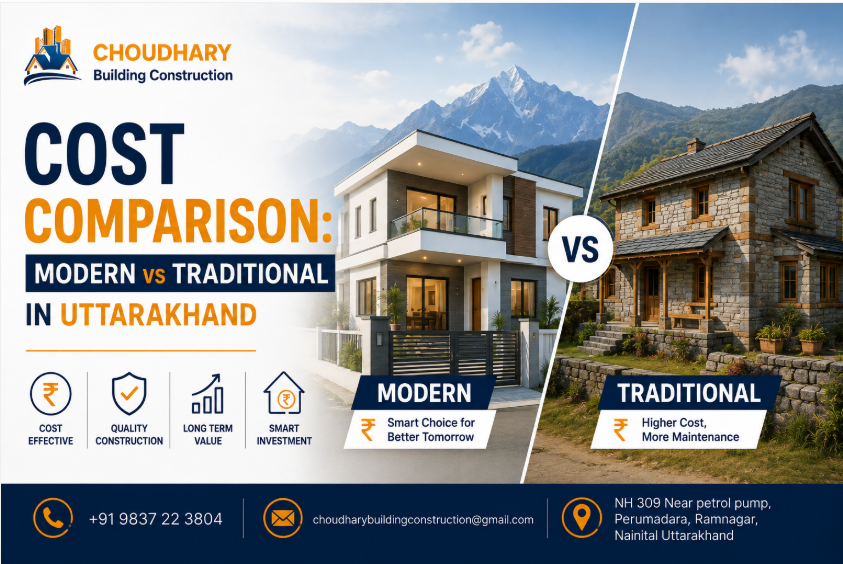
Cost Comparison: Modern vs Traditional in Uttarakhand
Modern homes usually carry higher upfront material costs, mostly from glass, steel, and the structural framing needed for open layouts and big window spans. Traditional homes often cost more in skilled craftsmanship instead, since good woodwork and stonework need experienced labor that isn’t cheap or always easy to schedule.
Realistically, overall cost comes down to design complexity and material choices far more than which style you pick. A simple modern home can end up cheaper than an elaborately detailed traditional one. Sometimes it’s the other way around. Getting a proper, stage-wise quote based on your actual design beats assuming one style is automatically the cheaper route.
How to Choose the Right Design for Your Home
A few honest questions cut through this faster than scrolling design photos for hours.
What’s your lifestyle actually like? Fast-paced, urban, that usually points modern. Family-oriented, rooted in local culture, that usually points traditional.
What’s your real budget? Tighter budgets often favor a simpler modern design. More flexibility opens the door to detailed traditional work or a well-executed hybrid.
Who’s actually living in this house? Nuclear families often gravitate toward modern. Joint families frequently prefer the separated, defined spaces traditional design gives them.
Aesthetics or day-to-day function, which matters more to you? Clean and simple leans modern. Rich and detailed leans traditional.
Why More Homeowners Are Choosing Custom, Hybrid Homes
Homeowners today are moving away from picking a style off a shelf and going custom instead, something that actually reflects their life, not a label. Your home should reflect how your family actually lives, not just fit neatly into “modern” or “traditional” as a category.
That’s a big part of why hybrid design has grown so much here specifically. It keeps the practical, climate-smart parts of traditional hill architecture while still giving you the open, functional layouts modern living generally asks for.
Common Mistakes Homeowners Make When Choosing a Design Style
A few patterns come up often enough here that they’re worth calling out directly.
- Picking a style purely off photos or trends without thinking about local climate and terrain
- Underestimating how much traditional detailing actually costs in skilled labor
- Assuming modern automatically means cheaper, which isn’t always true once material quality enters the picture
- Not bringing in an architect early enough to see whether a hybrid approach might actually suit the plot better than either pure style
- Dismissing Vastu entirely just because it gets associated with traditional design, even when it matters to the family
FAQs About Modern vs Traditional House Design in Uttarakhand
1. Which is more expensive, modern or traditional house design?
Depends more on material choices and design complexity than the style itself. Modern often means higher material costs, glass and steel mainly. Traditional often costs more in skilled craftsmanship and detailing.
2. Is traditional design better suited for Uttarakhand’s climate?
Generally, yes. Sloped roofs and thicker walls handle monsoon rainfall and temperature swings better than a typical flat-roofed modern design, though modern homes can be adapted with the right structural planning.
3. Can I combine modern and traditional elements in one home?
Yes, that’s exactly what hybrid design does. It’s become one of the more popular choices in this region specifically because it balances practicality with personal style.
4. Does modern design work well in hilly areas like Ramnagar or Nainital?
It can, but it needs more careful structural planning, particularly around roofing and drainage, since flat modern rooflines don’t handle heavy rainfall as naturally as sloped traditional ones.
5. Is Vastu Shastra only relevant for traditional homes?
No. Vastu principles work into modern, traditional, or hybrid designs equally. It’s a planning philosophy, not something tied to one architectural style.
6. Which design is better for a joint family?
Traditional generally works better for joint families, since it tends to offer more separated, defined rooms, though a well-planned hybrid layout can accommodate joint family needs too.
7. How do I decide between modern, traditional, and hybrid for my own home?
Start with lifestyle, budget, and who’s actually living there, then bring in an architect early so local terrain and climate can shape the final call.
8. Does Choudhary Builders build both modern and traditional homes?
Yes. Choudhary Builders works across modern, traditional, and hybrid designs, with expert planning and Vastu consultation available depending on what each project needs.
Final Thoughts on Modern vs Traditional House Design
There’s no single right answer here. Go modern if you want simplicity, tech, and efficient use of space. Go traditional if culture, comfort, and a timeless look suited to the local climate matter more to you. Go hybrid if you want the practical upsides of both without fully committing to either.
At Choudhary Builders, we don’t just build houses, we build homes that actually match your lifestyle, vision, and budget, whether that’s a fully modern build, a traditional home rooted in local architecture, or a custom hybrid blending both. Reach out for a consultation, and we’ll help you figure out what genuinely fits your plot, your family, and your budget.